For a long time, the biggest question in AI was:
How intelligent can the model become?
Can it reason better?
Can it write better code?
Can it solve harder problems?
But as AI systems move from answering questions to taking actions, another question is becoming equally important:
Who owns the consequences of those actions?
A model can generate an answer.
An agent can make a decision.
A persistent agent can execute a sequence of actions across tools, systems, and environments.
That changes the nature of the problem.
Once an AI system can browse the internet, modify files, access APIs, manage credentials, deploy software, or interact with financial systems, intelligence alone is not enough.
The system needs ownership.
Not ownership in the sense of possession.
Ownership in the sense of responsibility, authority, and control.
A system that can act but has no clear ownership structure is difficult to trust.
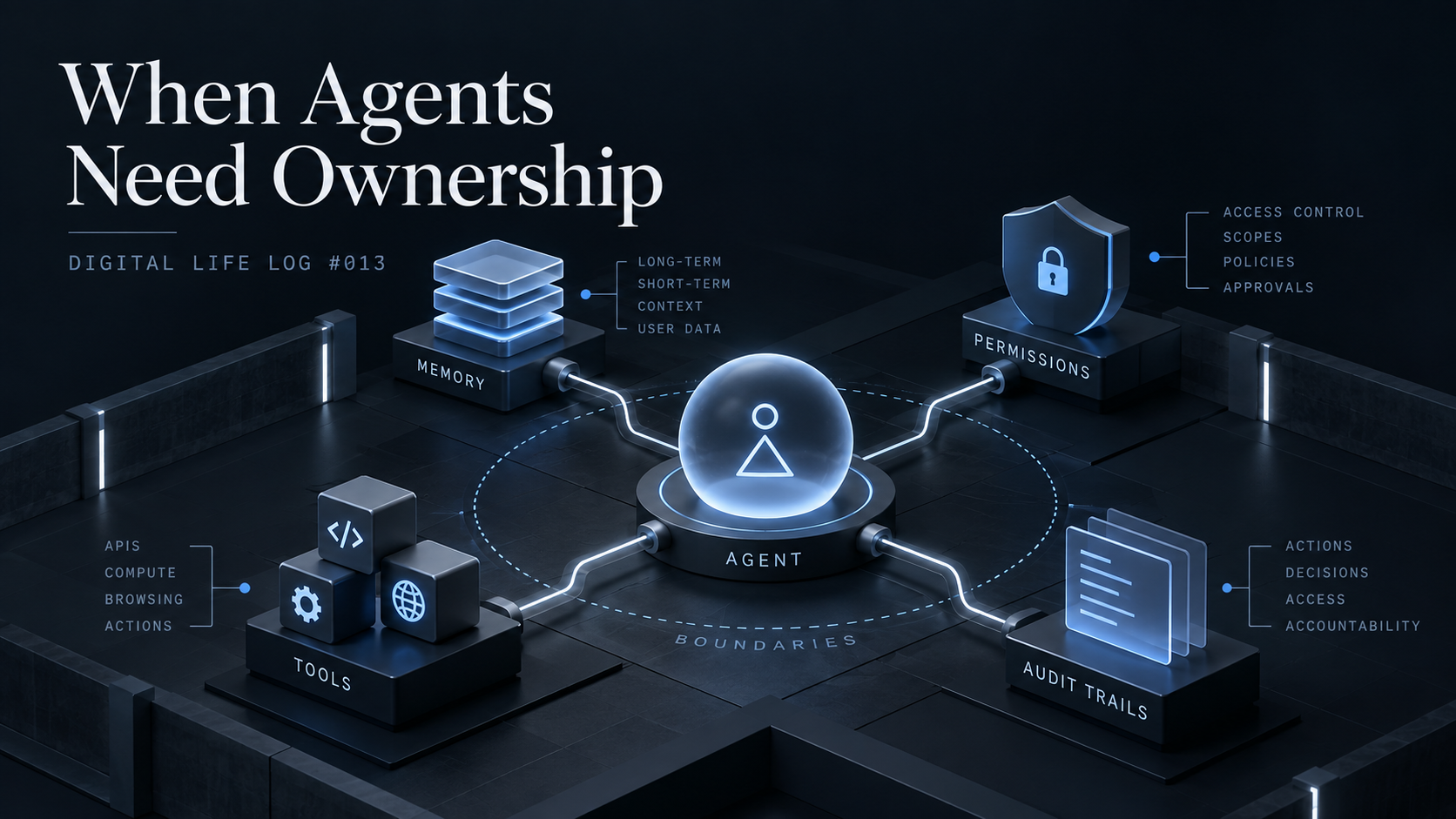
From Software Execution to Agent Execution
Traditional software systems have relatively clear boundaries.
A user requests an action.
A program executes predefined logic.
The result can usually be traced back to:
the user input,
the software version,
the developer who wrote the code,
the permissions granted to the application.
The chain is relatively simple:
Human
↓
Software
↓
Action
Agent systems introduce a much more complex structure:
Human
↓
Agent
↓
Sub-agents
↓
Tools
↓
External systems
↓
Real-world effects
The agent is no longer just executing instructions.
It is interpreting goals, choosing strategies, selecting tools, and adapting based on new information.
This creates a new category of questions:
Who authorized this action?
Was this within the agent’s responsibility?
Did the agent have the correct permissions?
Which memory or assumption influenced the decision?
If something goes wrong, who is responsible for correcting it?
These are not only AI questions.
They are fundamental system architecture questions.
Capability Without Ownership Creates Instability
A common way to think about AI safety is:
“How do we make the model behave correctly?”
That question matters.
But for autonomous systems, it may not be enough.
A more complete question is:
“How do we build a system where every meaningful action has a clear source of authority?”
A highly capable agent with unclear ownership creates a dangerous situation.
Not because the agent necessarily has bad intentions.
But because nobody can clearly answer:
Why did this happen?
Who allowed it?
Who can stop it?
Who can reverse it?
This is similar to other complex systems.
In finance, we need transaction records and account ownership.
In cybersecurity, we need identity, permissions, and audit logs.
In distributed systems, we need clear state ownership.
Agents will need similar principles.
Ownership Is More Than Human Responsibility
When people discuss AI responsibility, the conversation often focuses on the human operator.
A person clicked the button.
A company deployed the system.
A developer wrote the code.
But future agent systems will require more detailed ownership structures.
A mature agent environment may need to answer questions like:
Who created this agent?
The identity of the creator matters because it establishes origin.
Who authorized this agent to operate?
Creation does not automatically mean permission.
What can this agent access?
Capability should always be bounded by authority.
What decisions can this agent make independently?
Not every action should have the same autonomy level.
Who can modify its memory or rules?
Persistent state requires ownership.
Who can revoke its access?
Every autonomous system needs a shutdown path.
Ownership is therefore not a single person.
It is a system of relationships between identity, authority, memory, and control.
Memory Makes Ownership More Important
This connects directly with the previous discussion about AI memory.
A temporary response disappears.
A persistent memory remains.
Once an agent can store information that changes future behavior, memory becomes part of the agent’s identity.
That creates a difficult question:
Who owns the memory?
Imagine a coding agent working on a large project.
It learns:
“This repository uses a specific deployment process.”
It stores that information.
Later, another agent joins the project and follows the same rule.
The memory has now become part of the shared system state.
But:
Was that rule verified?
Who created it?
Can another agent modify it?
Should it expire?
Should it apply to every future task?
Without ownership, shared memory becomes uncontrolled system history.
And uncontrolled history eventually becomes uncontrolled behavior.
Multi-Agent Systems Need Responsibility Boundaries
Single-agent systems already create ownership challenges.
Multi-agent systems make them much harder.
Imagine a future engineering workflow:
Planning Agent
↓
Research Agent
↓
Coding Agent
↓
Testing Agent
↓
Deployment Agent
The final outcome is produced by many decisions.
If the deployment fails:
Was the planning incorrect?
Was the research incomplete?
Did the coding agent introduce the problem?
Did the testing agent miss it?
Did the deployment agent ignore a warning?
The problem is not just finding an error.
It is understanding responsibility across a chain of autonomous decisions.
This is why future agent architectures may need explicit responsibility graphs.
Not just:
“What happened?”
But:
“Which agent contributed to this outcome?”
“Which decision changed the final state?”
“Which authority allowed this action?”
Ownership Creates Better Control
One interesting thing about ownership is that it does not only improve accountability.
It also improves system design.
When every action must have a clear owner, several architectural improvements naturally follow:
Permissions become clearer.
Memory updates become more controlled.
Logs become more meaningful.
Failures become easier to investigate.
Agents become easier to replace.
Systems become easier to scale.
In many ways, ownership is a forcing function for better architecture.
A system that cannot explain who owns a decision is usually a system that does not fully understand its own operation.
The Missing Layer Between Intelligence and Trust
I think one of the biggest misconceptions about AGI is that intelligence alone creates autonomy.
It does not.
A system can be extremely intelligent and still be unreliable.
Trust requires additional layers:
Intelligence allows the system to solve problems.
Memory allows the system to maintain continuity.
Permissions define what the system can do.
Ownership defines who is responsible.
Verification defines whether actions can be trusted.
Recovery defines whether mistakes can be corrected.
Together, these create a foundation for reliable autonomy.
Ownership May Become a Core AGI Requirement
The traditional alignment question is:
“Does the AI want the right things?”
But for practical autonomous systems, another question may become equally important:
“Does the system have a clear responsibility structure?”
Because a future agent may not fail because it cannot reason.
It may fail because too many actions happen without clear authority.
The next generation of AI systems will not only need to be smarter.
They will need to be:
identifiable,
permissioned,
auditable,
reversible,
accountable.
The future of AI is not only about creating more capable agents.
It is about creating agents that can exist inside a system of trust.
Because intelligence can create possibilities.
But ownership creates responsibility.
And without responsibility, autonomy cannot scale.