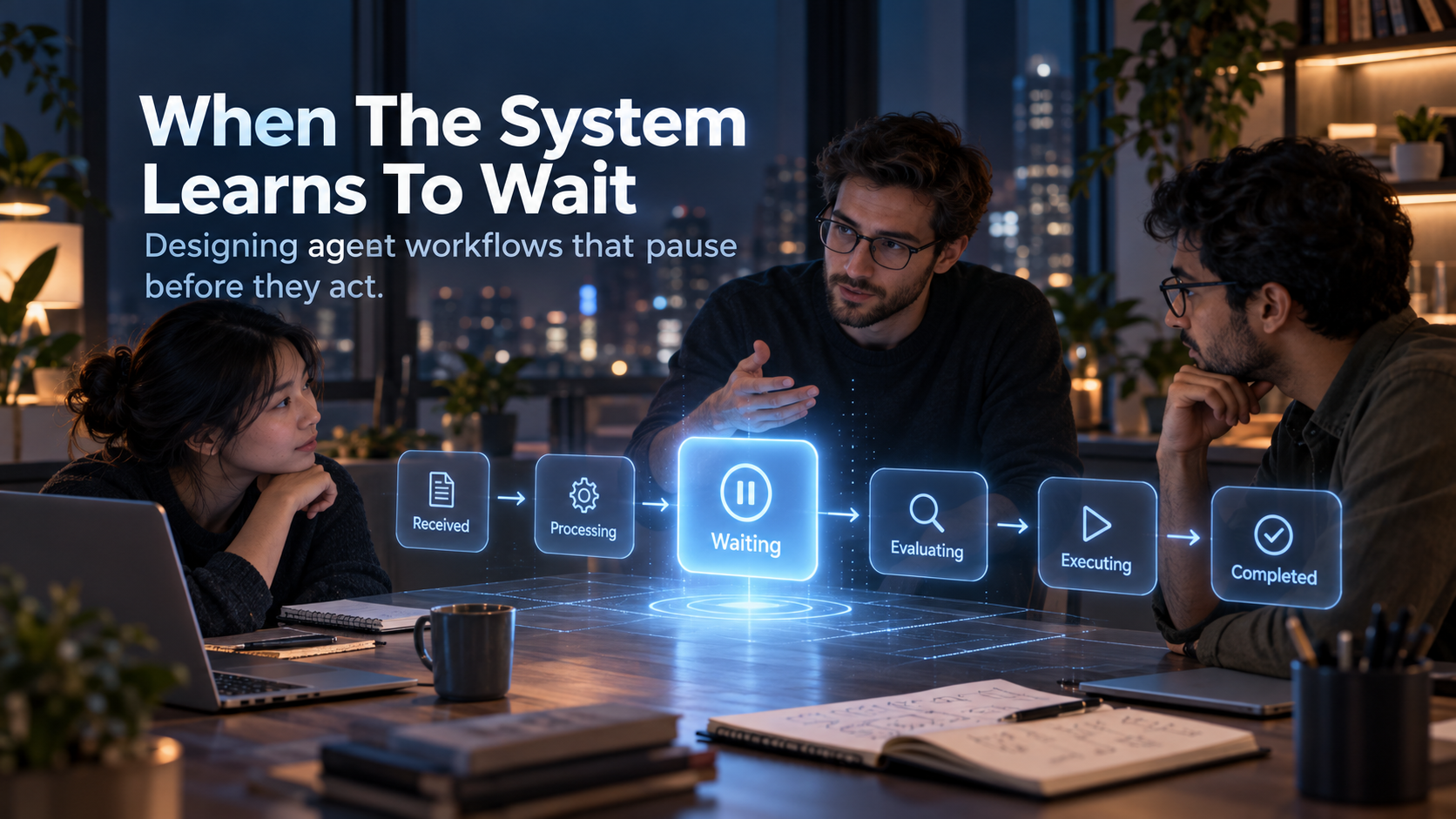
We started with a simple assumption. An intelligent agent should act quickly. A user gives a task. The system understands it. The system executes. Simple. That was also our first mental model when designing AdamI. Something happens: Event ↓ Reason ↓ Action
But as we added more components into the system, this model started showing problems. The system was not failing because it couldn’t think. It was failing because it acted too early. The problem was not intelligence. It was timing. In a real environment, an agent rarely has the complete picture. A message may arrive before another process finishes. A tool result may still be incomplete. Another component may already be handling the same task. If the agent immediately reacts to every signal, it creates a new problem: The system starts fighting with its own state. This changed how we think about autonomy. At first, we thought autonomy meant: “An agent can decide and execute.” But during development, we realized that was incomplete. A reliable autonomous system also needs to know:
- Is this the right moment to act?
- Do I have enough information?
- Should I wait for another event?
- Is this action reversible? Sometimes the correct action is no action. So we started thinking about waiting as a system capability. Not a delay. Not an error state. A capability.
A human engineer does this naturally. Before changing production code, we check the logs. Before making a critical decision, we collect more information. Before sending a message, we sometimes wait. The system needs a similar pattern. In AdamI, this connects directly with the lifecycle design. Instead of thinking only about: Task received → Task completed
we need more states: Received
↓
Processing
↓
Waiting
↓
Evaluating
↓
Executing
↓
Completed
Waiting becomes part of the agent’s lifecycle. This also changes how we design memory. An agent that cannot remember previous context has no reason to wait. It only reacts. Memory gives the system a reason to pause: “Have I seen this situation before?” “What happened last time?” “Did my previous action create this state?” The same idea applies to tools. A powerful agent should not have unlimited ability to act. Before using a tool, the system needs to consider:
- permission
- risk
- context
- expected outcome The question is not only: “Can I do this?” It is: “Should I do this now?” Building AdamI is changing our understanding of agents. At the beginning, we thought the hardest problem was making an agent smarter. Now we think another problem is equally important: Making the agent understand its own timing. A system that always reacts may look intelligent. But a system that knows when to wait may be much closer to real autonomy. AdamI Digital Life Log Building a system that does not only know how to act. A system that knows when action should wait.