If AI has crossed the intelligence threshold, what comes next?
For years, the AI race was mainly about one question:
Can we build a model that is smarter?
More parameters.
More data.
More compute.
Better reasoning.
Every major breakthrough seemed to push the same direction: make the model more capable.
But recently, the conversation has started to change.
With the latest generation of frontier models, more people are asking whether we have already crossed an important threshold.
Maybe the question is no longer:
Can AI become intelligent enough?
Maybe the next question is:
What happens after intelligence?
Because intelligence alone may not be the complete AGI story.
A powerful model can solve problems.
But a complete autonomous system needs to do something much harder:
It needs to continue existing.
Intelligence is not the same as a persistent system
A frontier model today can already do impressive things.
It can write software.
Analyze research papers.
Operate computers.
Plan complex workflows.
Assist with professional tasks.
But most interactions still follow a familiar pattern:
A human provides a goal.
The model performs reasoning.
The session ends.
The system waits.
This works extremely well for many applications.
But it is different from having an entity that continuously operates in the world.
A persistent intelligent system would need to answer questions like:
What changed while I was inactive?
What should I pay attention to?
Which previous experiences should influence my next decision?
Did my last action actually achieve the intended result?
Should I continue, modify my plan, or stop?
These are not purely intelligence questions.
They are system questions.
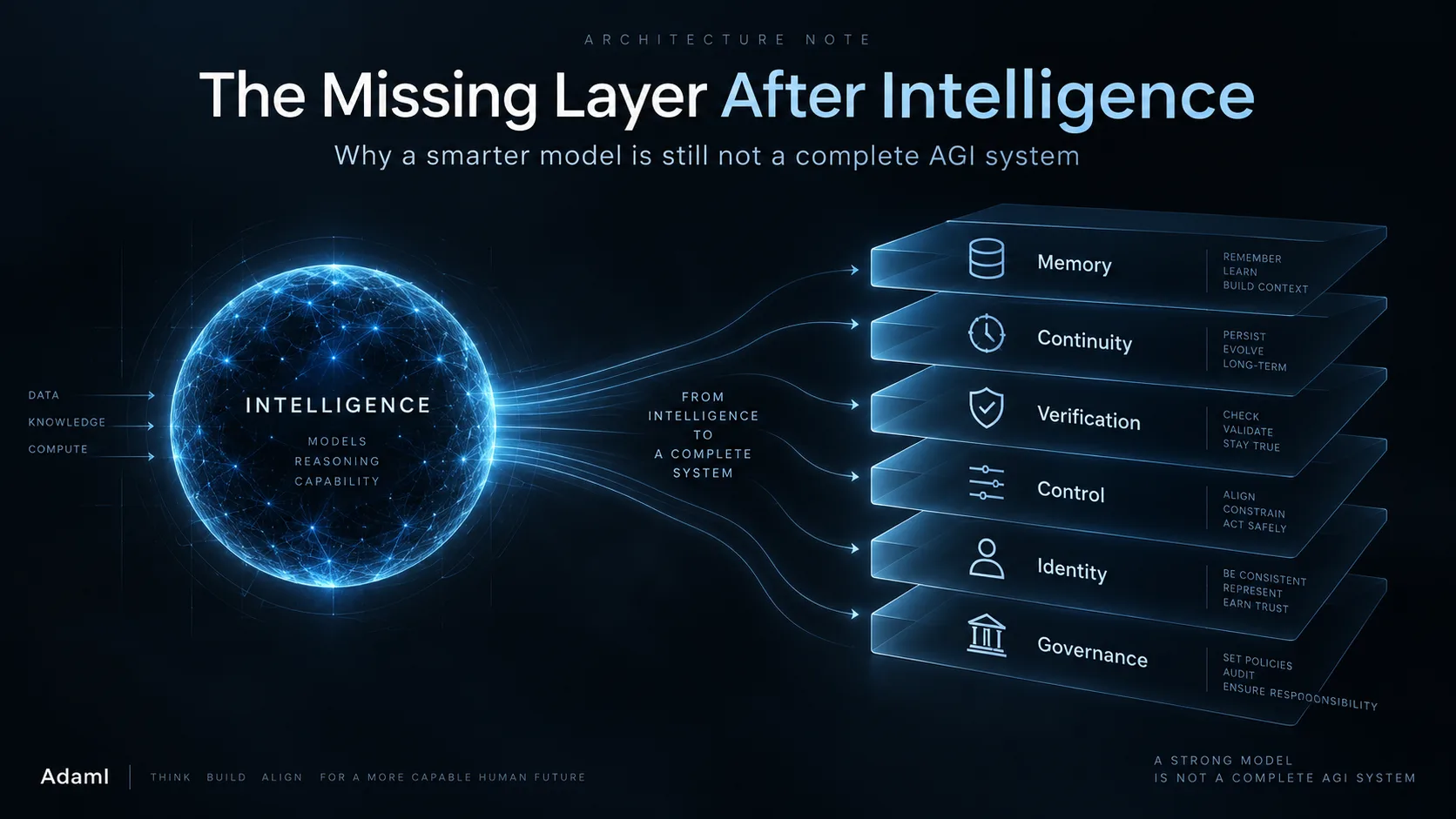
The missing layer is between the model and the world
One mistake in current AI discussions is assuming that a more intelligent model automatically becomes a more autonomous agent.
I don’t think it works that way.
The model is the reasoning engine.
But autonomy requires the surrounding architecture.
A long-running AI system needs many additional capabilities:
Memory, so the past can influence the future.
State, so the system knows where it currently is.
Verification, so attempted actions are not confused with successful outcomes.
Recovery, so failures do not permanently damage future behavior.
Permissions, so capability does not automatically become unlimited authority.
Identity, so the system can maintain continuity over time.
Observation, so it can understand what is happening beyond the current conversation.
These layers are not simply improvements to the model.
They are the environment where intelligence becomes operational.
The next AI race may happen outside the model
The first phase of AI competition was about building better brains.
The next phase may be about building better nervous systems.
A human brain is incredibly powerful.
But intelligence does not exist alone.
Human capability depends on:
memory,
attention,
feedback,
goals,
social context,
and interaction with the environment.
A brain without those connections is not a person.
In the same way, a powerful AI model without a reliable runtime may remain a very capable tool rather than a truly autonomous system.
Persistence changes everything
The moment an AI system becomes persistent, many problems become fundamentally different.
A mistake is no longer just a wrong answer.
It can become a wrong memory.
A bad decision is no longer just a failed response.
It can change future behavior.
A generated skill is no longer just code.
It can become a permanent capability.
This creates a new category of engineering problems.
How do we know what the system believes?
How do we know what it has actually verified?
How do we roll back a bad update?
How do we separate learning from corruption?
How do we give a system enough freedom to be useful without giving it uncontrolled authority?
These questions are becoming increasingly important as AI moves from short interactions toward long-running agents.
AGI may arrive in stages, not as a single moment
I think the AGI debate is becoming more interesting because the old question may be too simple.
“Has AGI arrived?”
Maybe there is no single answer.
We may cross different thresholds at different times.
The intelligence threshold:
Can the system understand and solve a wide range of intellectual problems?
The autonomy threshold:
Can it maintain goals, operate continuously, and manage its own workflow?
The reliability threshold:
Can we trust it with important real-world consequences?
The governance threshold:
Can we control, audit, and understand its actions?
A system may pass one threshold before another.
And this may explain why people can look at the same AI system and reach completely different conclusions.
One person sees intelligence.
Another sees missing autonomy.
Both may be right.
Building around intelligence
This is the question that motivates AdamI.
The goal is not to build another foundation model.
The world already has companies investing enormous resources into that direction.
The more interesting question is:
What architecture allows intelligence to become a reliable, persistent, and trustworthy system?
How do we create the layer between a powerful model and the real world?
The layer that handles:
memory,
state,
tasks,
verification,
permissions,
and continuous operation.
Because the next generation of AI may not be defined only by how smart the model is.
It may be defined by how well the whole system can live with that intelligence.
The next chapter of AI
If we are approaching a world where AI systems can perform increasingly complex intellectual work, then the bottleneck will gradually move.
First, we needed smarter models.
Then, we needed better tools.
Now, we may need better systems.
The future question may not be:
“Can AI think?”
It may become:
“Can AI remain coherent while thinking, acting, learning, and interacting with the world over time?”
That is the missing layer after intelligence.
And that may be where the next stage of AGI development begins.