A persistent agent can remember what happened.
That sounds useful until you realize something more basic still has to happen first:
the system has to notice that something changed.
That sounds almost trivial.
Files change. Emails arrive. APIs return different values. A task fails. A user updates a preference. A dependency disappears. A scheduled job wakes up and finds the world is no longer what it was when it went to sleep.
All of those are changes.
But a long-running system cannot treat every change as equally important.
If it does, it becomes noisy and reactive.
If it ignores too much, it becomes blind.
So the real problem is not simply detecting change.
It is deciding which changes actually matter.
That is the part I have been thinking about.
Seeing is not the same as noticing
A system can observe a thousand things without really understanding any of them.
A file watcher can tell you that a file was modified.
A mailbox integration can tell you that a new message arrived.
A monitoring service can tell you that latency increased.
A scheduler can tell you that three hours passed.
Those are signals.
But a persistent agent eventually needs to answer a harder question:
Does this change deserve attention?
That requires context.
A new email from a newsletter is different from a new email from someone blocking a project.
A small price move may mean nothing most of the time, but matter a lot if the system is already watching a risk threshold.
A failed task might be normal if it is retryable.
The same failure after five attempts may deserve escalation.
The raw event is the same kind of thing.
Its meaning changes because of everything around it.
This is where autonomy may actually begin
We usually talk about autonomy in terms of action.
Can the agent call tools?
Can it execute a plan?
Can it keep working without asking for permission every few minutes?
But I think there is an earlier step.
Before an autonomous system decides what to do, it has to decide what is worth doing anything about.
That is a different problem.
A system that only responds when a human gives it a task is still reactive.
A more persistent system needs some way to notice that the environment changed enough to create new work.
That might be:
a dependency failed,
a deadline moved,
a new message changed the situation,
a previous assumption is no longer true,
or a task that was waiting now has enough information to continue.
The interesting part is not the event itself.
It is the transition from:
“something happened”
to:
“this matters”
to:
“I should create or modify a task.”
That transition feels like one of the missing pieces between persistence and real agency.
The problem is significance
Significance is difficult because it is rarely absolute.
The same event can be important in one context and irrelevant in another.
Imagine a persistent coding agent watching a repository.
A file changes.
Should it react?
Maybe not.
Was the file changed by another agent working on the same project?
Now it matters more.
Did the change modify an interface the current task depends on?
That matters even more.
Did the change invalidate an assumption the agent made twenty minutes earlier?
Now the system may need to stop and re-plan.
The event did not become more dramatic.
The context changed its significance.
This is why I do not think perception for persistent agents is just about adding more sensors or connectors.
The harder part is interpreting events against current state, active goals, history, and risk.
Too much attention is also a failure mode
There is another side to this.
A system that notices everything can become useless.
Imagine an agent that creates a task every time:
a log line appears,
a file timestamp changes,
a price moves slightly,
an API returns a warning,
or another agent updates shared state.
It would spend all its time responding to noise.
Persistent agents need something like attention management.
Not in the human psychological sense.
More in the practical sense of:
What can be ignored?
What should be remembered but not acted on?
What should update an existing task?
What should create a new task?
What should interrupt current work?
What should require human review?
These decisions are probably going to matter a lot more as agents stay active for longer periods.
The longer the system runs, the more events it sees.
And the more important filtering becomes.
Time changes the meaning of events
Persistence also adds another dimension that short-lived agents rarely have to think about:
time.
Some events matter immediately.
Others only become important because they persist.
One failed request may be nothing.
The same failure every hour for a day is different.
A user not replying for ten minutes is normal.
A user not replying for a week might change the plan.
A task that is blocked for thirty seconds is waiting.
A task blocked for three days may need to be reconsidered.
This means significance is not only about what happened.
It can also depend on:
how long it has been true,
how often it has happened,
whether the situation is getting worse,
and whether previous attempts changed anything.
That is where a persistent system starts needing a real sense of temporal context.
Memory should affect what the system notices
This connects directly to the memory problem.
Earlier, I kept asking a simple question:
If memory disappears, does future behavior change?
The same idea applies here.
If the system has experienced the same failure before, that should affect how it interprets the next one.
If a certain warning has always been harmless, maybe it should not trigger the same response every time.
If a particular pattern has repeatedly led to failure, the next occurrence should probably receive more attention.
That is where memory becomes more than storage.
It starts shaping perception.
The system is no longer just remembering the past.
The past is changing what the system considers important now.
That feels much closer to useful continuity.
A change should not automatically become a task
One thing I want to avoid in AdamI is a simple rule like:
event detected → create task
That would be easy to implement.
It would also create a mess.
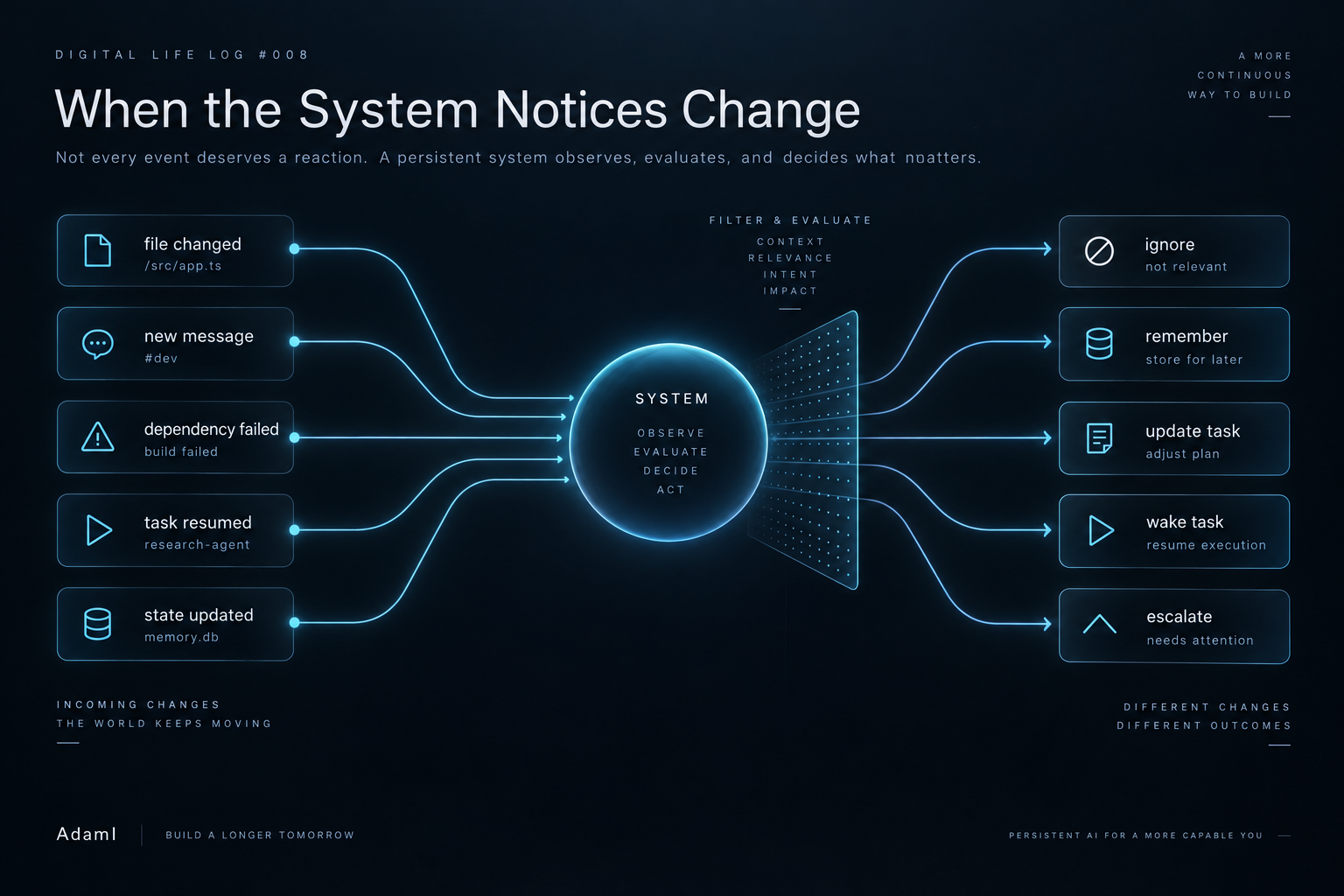
A better system probably needs several stages between observation and action.
Something changes.
The system records it.
Then it asks whether the event is relevant to anything it currently cares about.
If it is relevant, it asks how significant it is.
Only then should it decide whether to:
ignore it,
store it,
update an existing task,
wake a waiting task,
create a new task,
or escalate to a human.
The exact mechanism is still open.
I do not have a mature significance engine in AdamI today.
There are already pieces that make this possible: persistent task state, background processing, memory, lifecycle handling, waiting and resuming, and a control layer around execution.
But the part that decides when a change deserves new attention is still incomplete.
That is the part I want to explore next.
The system should also know when not to react
This connects to something from the previous log.
Autonomy is not just knowing when to act.
It is also knowing when to wait.
Now I think there is another step before that:
knowing when something is not important enough to interrupt the current plan.
A mature persistent agent should probably be able to say:
“I noticed this.”
“I understand what changed.”
“It does not matter enough to act on yet.”
That sounds simple, but it is a very different system from one that either ignores events completely or reacts to everything.
A useful agent needs restraint.
Otherwise persistence becomes constant activity.
And constant activity is not autonomy.
It is just noise with tools.
From persistence to agency
This is why I increasingly see persistence as only the beginning.
Keeping state alive across time is necessary.
But persistence alone does not tell the system what deserves attention.
Memory alone does not decide what matters.
Tools alone do not decide when they should be used.
A system starts to look more agentic when it can connect these pieces:
the world changes,
the system notices,
it understands why the change matters,
and then it decides whether anything should happen next.
That is a much more interesting loop than:
prompt in,
answer out.
And it is probably one of the places where long-running AI systems will start to feel fundamentally different from today’s assistants.
For AdamI, the next question is becoming clearer:
How does a persistent system decide that something changed enough to deserve a new task?
I do not think the answer is just “more intelligence.”
It is probably a combination of memory, current state, time, priorities, and context.
That is the layer I want to work on next.