Most AI systems start when you send them a request.
You ask.
They think.
They respond.
And then they stop.
But a Digital Life can’t work that way.
If it is supposed to exist continuously, something has to keep it alive even when nobody is talking to it.
I don’t want the LLM to be the operating system.
The model is one cognitive component inside the system.
The system itself needs to have its own lifecycle.
The brain should not have to remember to keep the body alive.
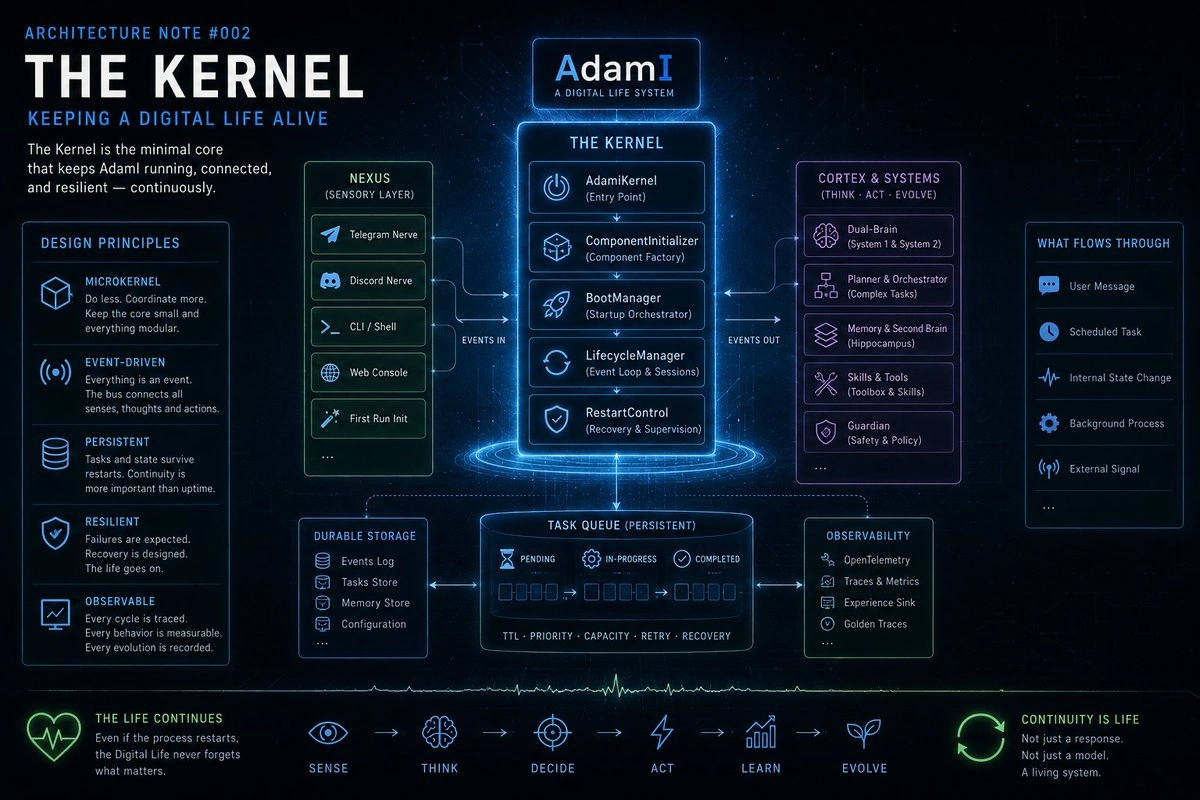
The Kernel itself is intentionally small.
It doesn’t try to do everything.
Its job is to initialize the system, coordinate startup, manage lifecycle and keep the runtime moving.
The actual capabilities live in independent components.
This makes the architecture modular.
Memory doesn’t need to become part of the Kernel.
Skills don’t need to become part of the Kernel.
The reasoning system doesn’t need to become part of the Kernel.
They can evolve independently.
A Digital Life needs to be event-driven.
Messages are only one type of event.
A scheduled process can be an event.
An internal state change can be an event.
A background task can be an event.
An external signal can be an event.
The Event Bus becomes the nervous system connecting them.
But an event-driven system still has a problem:
What happens when the process stops?
A real runtime can’t assume that every task finishes immediately.
So AdamI uses a persistent task queue.
Tasks can exist independently of a single execution cycle.
If the process restarts, the runtime can recover the queue instead of simply forgetting everything that was waiting.
Persistence turns execution into continuity.
A 24/7 system doesn’t mean a process can never fail.
It means failure doesn’t necessarily mean the end of the entity.
Processes can crash.
Machines can restart.
Networks can disappear.
APIs can fail.
The architecture needs to treat these as runtime events — not existential events.
In Architecture Note #001, I described the Dual-Brain Architecture:
Fast local action.
Deep cloud reasoning.
But the brains alone aren’t enough.
They need a body that keeps the system running.
They need a nervous system that carries events.
They need a lifecycle that survives individual tasks.
They need memory that survives restarts.
The brain provides cognition.
The kernel provides continuity.
I’m still far from calling this a Digital Life in the strongest sense.
The engineering maturity is still early.
But this is the direction I’m exploring:
not a model that waits for a prompt,
but a system that maintains its own continuous runtime.
Architecture Note #002
The Kernel — Keeping a Digital Life Alive.