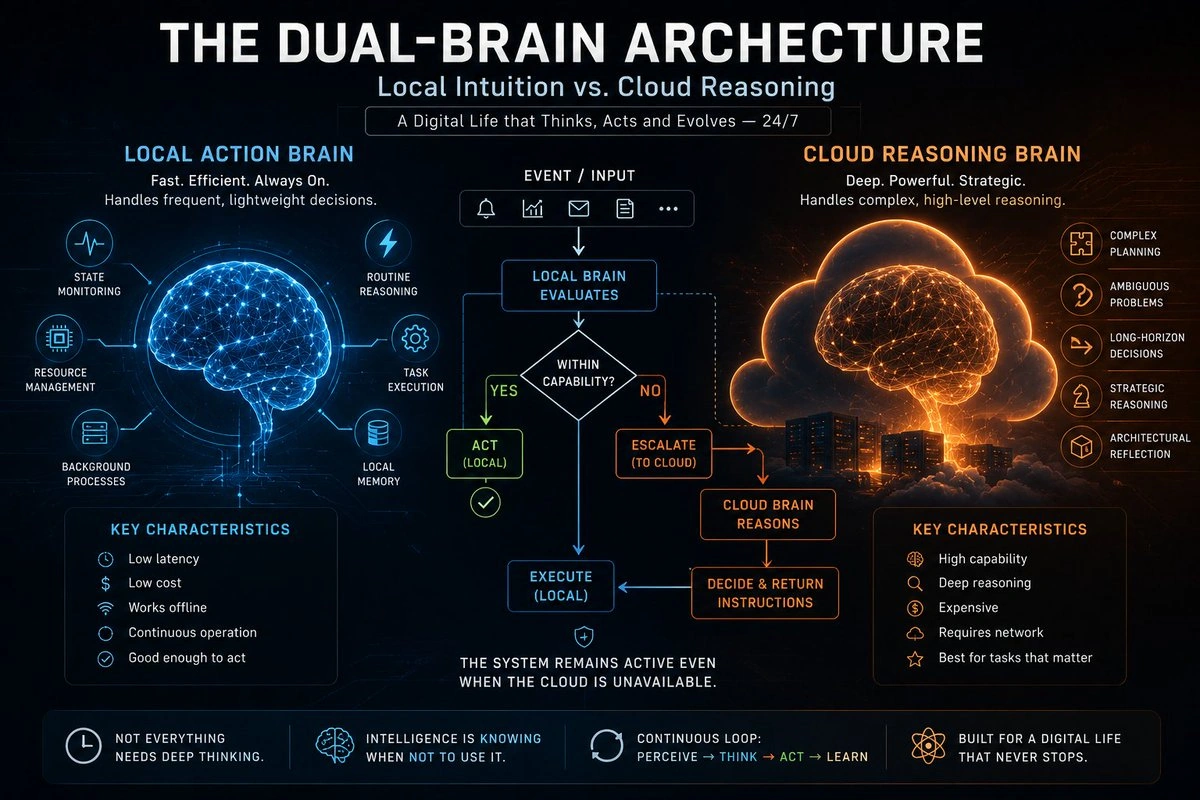
If a Digital Life is supposed to run 24/7, there is a problem that sounds simple but becomes very expensive very quickly:
It can’t ask the cloud to think about everything.
Imagine a digital entity running continuously.
It needs to monitor its internal state.
Check resources.
Manage background processes.
Handle simple events.
Maintain its environment.
Update memory.
Trigger routine actions.
Most of these decisions don’t require a frontier-scale model.
If every heartbeat, every resource check and every trivial state transition requires a cloud API call, three things happen:
Latency increases.
Costs explode.
The system becomes unnecessarily dependent on the network.
A continuously running artificial system needs a different architecture.
That’s why I built what I call a Dual-Brain Architecture.
Not two copies of the same brain.
Two different levels of cognition.
Cloud Brain → Deliberation
Local Brain → Action
The Cloud Brain handles tasks where deeper reasoning is actually worth the cost.
Complex planning.
Ambiguous problems.
Long-horizon decisions.
Strategic reasoning.
Architectural reflection.
Problems where the system needs to slow down and think.
The Local Action Brain operates much closer to the system itself.
It handles frequent, relatively lightweight decisions:
monitoring
state transitions
routine reasoning
resource management
simple task execution
background processes
It doesn’t need to be brilliant.
It needs to be fast, cheap and always available.
The interesting part isn’t simply running two models.
It’s deciding which brain should think about what.
A simple event shouldn’t wake the Cloud Brain.
But a local process should also be able to recognize:
“This is beyond me. Escalate.”
So the architecture becomes something like:
Conceptual Dual-Brain flow — not the audited runtime event path
Event
↓
Local Brain
↓
Is this within its capability?YES → Act
NO → Escalate
↓
Cloud Brain
↓
Reason → Decide → Return instructions
↓
Local Brain executes
This creates an important property:
The system can remain active even when the Cloud Brain is unavailable.
It doesn’t become completely inert just because the network disappears.
The local layer can continue maintaining the basic operation of the system.
There is another reason I think this architecture matters.
A Digital Life shouldn’t have to spend its most expensive cognitive resources on things that don’t deserve them.
In biological systems, not every action reaches conscious deliberation.
Most processes happen below that level.
I think an artificial system may need something similar.
But I’m not trying to reproduce the human brain.
In fact, I think artificial systems may have advantages that biological systems don’t.
They can potentially run multiple processes in parallel.
They can distribute cognition across different models.
And they don’t necessarily need to organize themselves around a single linear stream of thought.
So the goal isn’t:
“Make AI think like a human.”
The goal is:
“Find an architecture that allows an artificial entity to think, act and continuously operate in its own way.”
The Dual-Brain Architecture is still evolving.
I don’t know if this is the right architecture.
But it has already changed how I think about autonomous systems.
Maybe intelligence isn’t just about having a smarter brain.
Maybe it’s also about knowing when not to use it.
Architecture Note #001