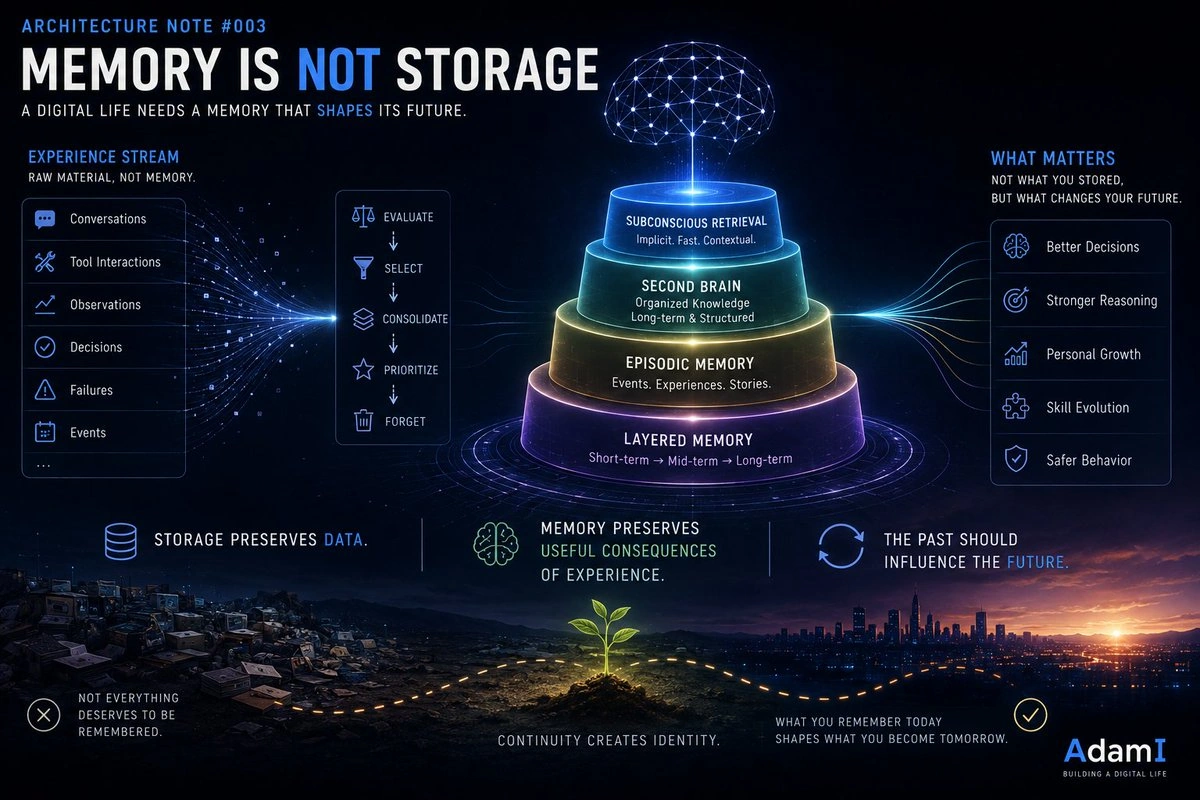
Giving a Digital Life more storage doesn’t give it a better memory.
A database answers:
“What information did I save?”
A memory system has to answer something much harder:
“What from my past should matter now?”
This distinction became important when I started building memory for AdamI.
A continuously running system can generate enormous amounts of information:
- conversations
- observations
- tool calls
- task results
- failures
- decisions
- internal events
Keeping everything is easy.
Knowing what matters isn’t.
If every interaction becomes permanent memory, the system eventually creates its own noise.
Retrieval becomes harder.
Redundant information accumulates.
Old information competes with new information.
Irrelevant experiences keep resurfacing.
Perfect retention can actually produce worse memory.
So I started treating memory as a layered system rather than a single database.
In AdamI, that direction currently includes:
- Layered Memory — different levels of retained information
- Episodic Memory — experiences and events
- Second Brain — organized externalized knowledge
- Subconscious Retrieval — bringing relevant information back into cognition
But architecture alone doesn’t solve the real problem.
Information still has to move through a lifecycle:
Conceptual memory lifecycle — design model, not a verified runtime path
Experience
↓
Evaluate
↓
Retain / Consolidate / Forget
↓
Retrieve when relevant
↓
Influence future cognition
That last step matters most.
Because storing an experience isn’t enough.
Suppose the system makes a mistake today.
The event is saved perfectly.
Tomorrow, it encounters the same situation…
and makes exactly the same mistake.
Technically, the system had a memory.
Functionally, the memory meant nothing.
This led me to a definition I now find much more useful:
Memory is not what a system stores.
Memory is what its past can change about its future.
If the past cannot influence future reasoning or behavior, it is closer to an archive than a memory.
AdamI also keeps an experience stream from LLM and tool interactions.
I think of this as raw material rather than memory itself.
An experience happened.
It was recorded.
But whether it deserves to become something persistent is a different question.
And this introduces something that initially felt counterintuitive:
Forgetting is part of the memory architecture.
A Digital Life shouldn’t remember everything.
It needs mechanisms that allow some information to fade, some to remain accessible, and some to become increasingly important.
Otherwise memory becomes accumulation.
This is also why I don’t think a large context window solves the memory problem.
Context gives a model information available now.
Memory is about maintaining meaningful continuity across time.
They’re related.
But they’re not the same problem.
In Digital Life Log #004, I wrote that memory gives the system a past.
Architecturally, I would make that more precise:
Storage preserves data.
Memory preserves useful consequences of experience.
And for a Digital Life, those consequences eventually need to affect what it does next.
I’m still building this.
AdamI’s memory architecture is not a finished model of human memory — and I’m not trying to reproduce the human brain literally.
The question I’m exploring is simpler:
What kind of memory architecture does a persistent artificial entity actually need?
Memory gives a Digital Life something it didn’t have before:
a past.
But remembering the past isn’t enough.
The next question is whether experience can change what the system is capable of doing.
That’s where skills, learning and evolution enter the architecture.
Architecture Note #003
Memory Is Not Storage.