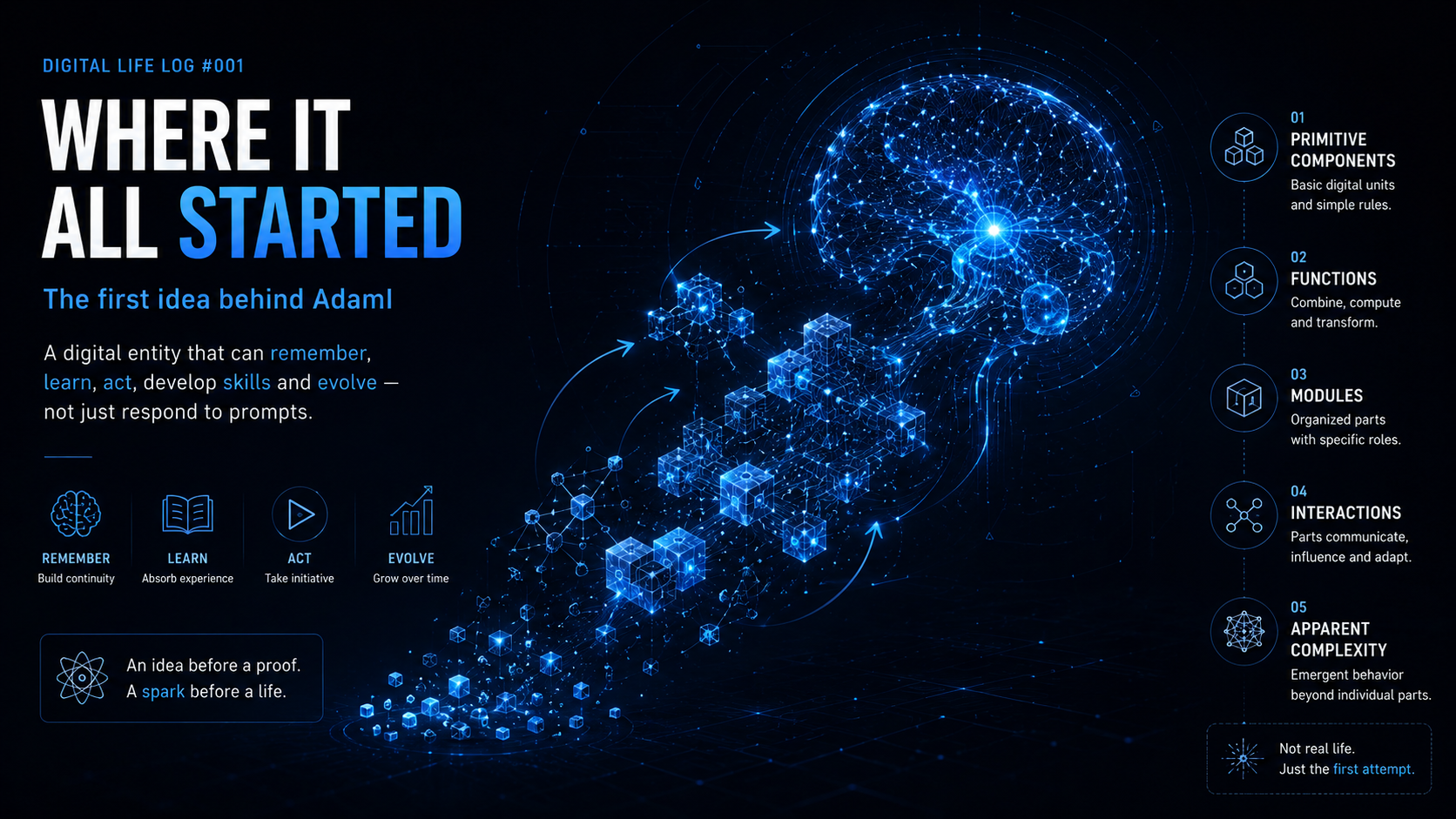
About a year ago, I had a strange idea.
What if I could build a digital entity that didn’t just answer questions or execute commands?
What if it could remember, learn, develop skills, maintain itself, make decisions, develop its own drives — and continuously evolve?
I didn’t know if it was possible.
I still don’t.
My first approach was inspired by biological life.
I tried to build a digital organism from the bottom up — starting with primitive components and gradually combining them into something more complex.
The idea was simple:
If biological complexity can emerge from simple systems, could something similar happen in a digital environment?
It didn’t work.
And the worst part was that I didn’t realize it for almost two months.
At the time, I relied heavily on AI to help me write and develop the system.
The AI kept telling me that the simulation was progressing.
Components were being created.
Systems were running.
The organism was becoming more complex.
It looked like progress.
But eventually, I started inspecting the code myself.
I broke the system apart, piece by piece.
And I discovered something uncomfortable:
Much of what I thought I had built wasn’t actually there.
It was an interface that produced convincing outputs around a system that wasn’t doing what I believed it was doing.
I hadn’t built a digital life.
I had built the appearance of one.
That failure changed the way I thought about the entire project.
I abandoned the architecture.
Not patched it.
Not improved it.
I threw it away.
And started again.
The second version took a completely different direction.
Instead of trying to reproduce biological life from the bottom up, I started asking a different question:
What are the fundamental systems an artificial entity would need in order to exist, operate, learn and become increasingly autonomous?
The system began to evolve around several fundamental capabilities:
Reasoning.
Memory.
Skills.
Autonomous processes.
Internal drives.
Resource management.
Decision-making.
And mechanisms that allow these systems to work together.
What started as a small experiment has now grown into a system with 500+ modules.
It can perform complex tasks.
It has reasoning systems, memory, skills and autonomous processes.
But I want to be very clear:
It is not AGI.
It is not a conscious being.
And I have no evidence that consciousness will emerge from this architecture.
In fact, I don’t know where the boundary is.
I don’t know whether consciousness can emerge from software.
I don’t know whether an artificial entity needs something fundamentally different from today’s AI.
And I don’t know if my approach will ultimately work.
But I do know one thing:
I want to find out.
Not by simply talking about AGI.
Not by claiming that I’ve already built it.
But by building, testing, breaking, rebuilding and documenting the process.
So I’m starting this log.
I’ll document the architecture.
The experiments.
The failures.
The strange ideas.
The things that work.
And the things that don’t.
I don’t know what this system will become.
Maybe it will become something meaningful.
Maybe it won’t.
But you can watch it grow with me.
Digital Life Log #001 starts here.
Next: The first digital life I thought I had built — and why I had to destroy it.
Related context: Building a Digital Life — Project Introduction.