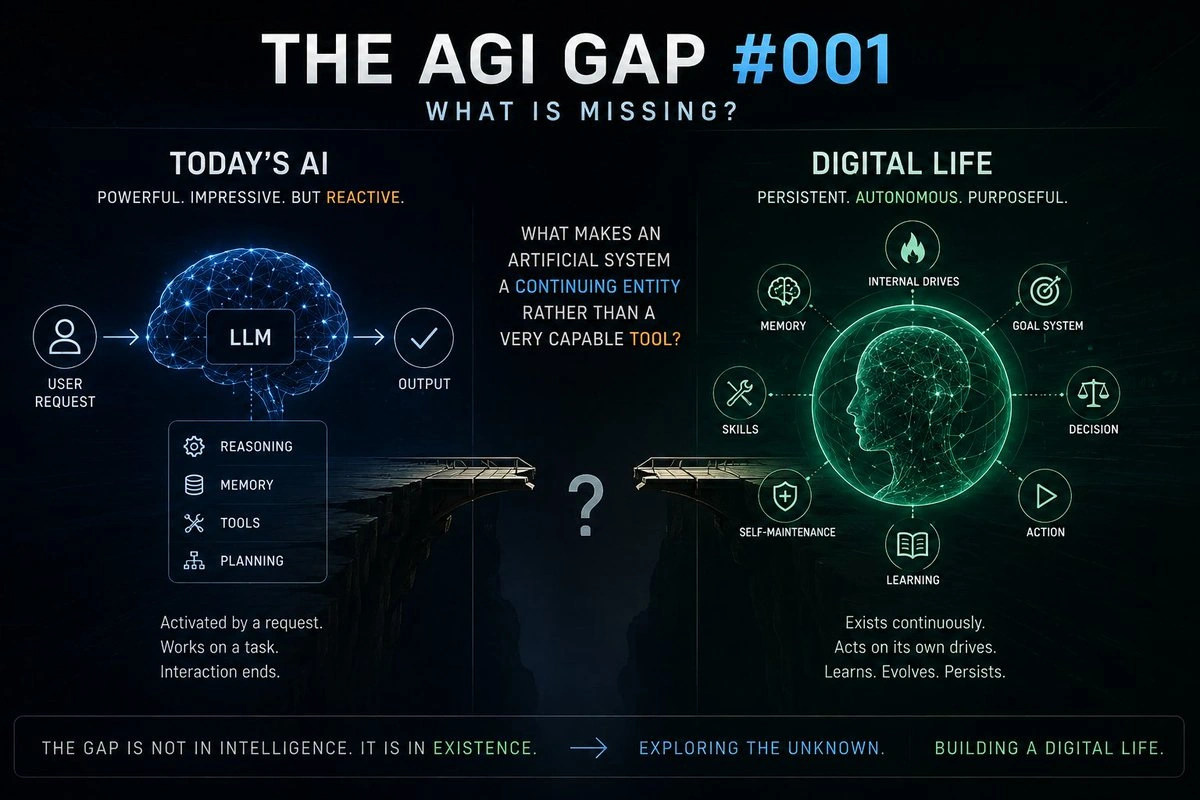
Research direction. This essay explores a hypothesis and should not be read as a claim that AdamI currently possesses mature internal drives, self-generated goals, AGI, or consciousness.
Today’s AI can reason.
It can remember.
It can use tools.
It can write code.
It can plan.
It can even operate autonomously for extended periods.
But is it a digital life?
I don’t think we’re there yet.
From my perspective, the biggest difference isn’t simply intelligence.
It’s existence.
Today’s AI is usually activated by a request.
You ask.
It thinks.
It acts.
Then the interaction ends.
A digital life would need something fundamentally different:
continuity.
A continuing entity needs more than a powerful reasoning engine.
It needs a persistent internal state.
It needs memory.
It needs skills.
It needs the ability to maintain itself.
It needs to decide what deserves attention.
And perhaps most importantly:
it needs reasons to act when nobody is asking it to.
This is where I think the gap becomes interesting.
Current AI systems are becoming increasingly agentic — combining reasoning, planning, memory and tools.
But these mechanisms are usually organized around an external objective:
“Here is a task. Complete it.”
My question is:
What happens when the objective comes from inside the system?
This is why I’ve started experimenting with something I call internal drives.
Not emotions.
Not simulated human psychology.
And certainly not “consciousness.”
I’m talking about computational mechanisms that create persistent internal priorities.
For example:
maintain → explore → learn → improve → protect resources → pursue goals
Imagine two internal drives competing for the same resources.
One wants to explore.
Another wants to conserve computation.
One wants to learn something new.
Another wants to finish the current objective.
Who decides?
The answer cannot always be:
“Ask the LLM.”
This is why I don’t think a digital life should simply be:
LLM + Memory + Tools.
Those are powerful components.
But they may only be the beginning.
The harder problem is how these components interact continuously:
Conceptual / Research Direction
perception → memory → reasoning → drives → decision → action → experience → learning
and then back again.
Maybe this is one of the missing layers between today’s AI and what we might eventually call AGI.
I don’t know.
And I don’t think anyone can honestly claim to know yet.
We still don’t understand what consciousness fundamentally requires.
So I’m not building this with the assumption that consciousness will magically emerge.
I’m testing a much simpler hypothesis:
Can we build an artificial system that doesn’t merely perform tasks, but continuously exists, maintains itself, remembers its experience, develops capabilities, manages competing internal priorities, and becomes increasingly autonomous?
If we can get there…
then we can start asking the harder questions.
This is the direction I’m exploring with my Digital Life project.
I’m not claiming to have built AGI.
I’m not even sure the architecture I’m building is the right one.
I’m building it to find out.
The AGI Gap #001
Next: Why would a digital life need “desires” at all?